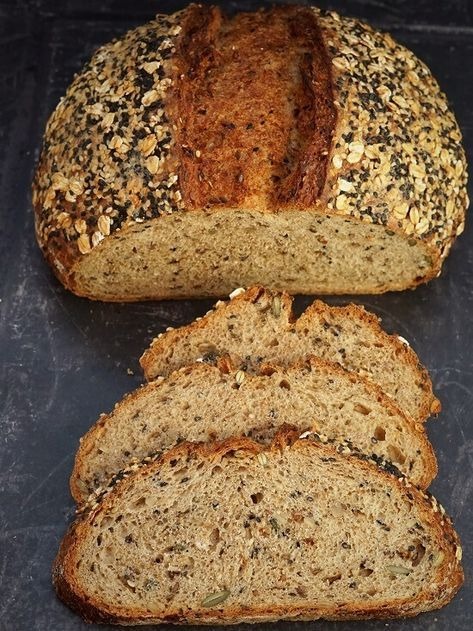
This beautiful seeded multigrain bread has a hearty, rustic appearance, a crisp golden crust, and a soft, flavorful interior packed with wholesome grains and seeds. The outside is generously coated with a mixture of sesame, sunflower, pumpkin, flax, and other seeds, while the loaf itself has a slightly nutty flavor and satisfying chew. It is wonderful toasted for breakfast, served with soup, or used for sandwiches.
Ingredients
For the Dough
- 3 cups bread flour
- 1 cup whole wheat flour
- 1/2 cup rolled oats
- 2 tablespoons ground flaxseed
- 1 tablespoon chia seeds
- 1 tablespoon sunflower seeds
- 1 tablespoon pumpkin seeds, finely chopped
- 1 3/4 teaspoons salt
- 2 teaspoons instant yeast
- 1 3/4 cups warm water
- 1 tablespoon honey or maple syrup
- 2 tablespoons olive oil
For the Seed Coating
- 2 tablespoons sesame seeds
- 2 tablespoons sunflower seeds
- 2 tablespoons pumpkin seeds
- 1 tablespoon flaxseeds
- 1 tablespoon poppy seeds
- 1 tablespoon rolled oats
- 1 tablespoon black sesame seeds, optional
Instructions
1. Prepare the Dough
In a large mixing bowl, combine the bread flour, whole wheat flour, rolled oats, ground flaxseed, chia seeds, sunflower seeds, chopped pumpkin seeds, salt, and instant yeast. Stir thoroughly so the ingredients are evenly distributed.
In a separate bowl or measuring jug, combine the warm water, honey or maple syrup, and olive oil. The water should feel comfortably warm rather than hot. Very hot water can interfere with the yeast.
Pour the liquid mixture into the dry ingredients. Stir with a wooden spoon or sturdy spatula until a rough, sticky dough forms. There should be no large pockets of dry flour remaining.
2. Knead the Dough
Transfer the dough to a lightly floured work surface. Knead for approximately 8 to 10 minutes, until it becomes smoother and more elastic.
Because whole wheat flour, oats, and seeds absorb moisture, the dough may initially seem sticky. Resist adding too much flour. A slightly tacky dough generally produces a softer loaf.
Alternatively, knead the dough using a stand mixer fitted with a dough hook. Mix on low speed until combined, then knead on medium-low speed for about 6 to 8 minutes.
Shape the dough into a ball and place it in a lightly oiled bowl. Cover with plastic wrap, a reusable cover, or a clean kitchen towel.
3. Let the Dough Rise
Allow the dough to rise in a warm, draft-free area for approximately 1 to 1 1/2 hours, or until it has noticeably increased in size.
The exact rising time depends on room temperature. In a cooler kitchen, the dough may need additional time.
While the dough rises, prepare the seed mixture by combining the sesame seeds, sunflower seeds, pumpkin seeds, flaxseeds, poppy seeds, rolled oats, and black sesame seeds in a shallow dish.
4. Shape the Loaf
Once the dough has risen, gently turn it onto a lightly floured surface. Avoid aggressively punching out all the air.
Shape the dough into a round boule by folding the edges toward the center and then turning it over. Gently tighten the surface by pulling the dough toward yourself across the work surface.
For the beautiful round loaf shown, use a generously floured proofing basket or a bowl lined with a well-floured kitchen towel.
Lightly mist or brush the outside of the dough with water. Roll or press the loaf gently into the prepared seed mixture, covering as much of the surface as possible.
Place the seeded loaf seam-side up in the proofing basket.
5. Second Rise
Cover the shaped loaf and allow it to rest for 30 to 45 minutes. It does not necessarily need to double in size. It should simply become slightly puffy.
Meanwhile, place a Dutch oven with its lid inside the oven and preheat to 450°F (230°C) for at least 30 minutes.
6. Score and Bake
Carefully turn the dough onto a sheet of parchment paper. Using a very sharp knife or bread lame, make one long slash across the top of the loaf. A deep central score creates the attractive opening seen on many artisan breads.
Carefully transfer the loaf, using the parchment as a sling, into the preheated Dutch oven.
Cover with the lid and bake for 25 minutes. The covered environment traps steam, helping the bread develop a crisp, beautifully blistered crust.
Remove the lid and reduce the oven temperature to 425°F (220°C). Continue baking for another 20 to 25 minutes, or until the loaf is deeply golden brown.
The bread should sound hollow when tapped on the bottom. If you have an instant-read thermometer, the center should reach approximately 200–205°F (93–96°C).
7. Cool Completely
Remove the loaf from the Dutch oven and transfer it to a wire rack. Allow it to cool for at least 1 hour before slicing.
Although it may be tempting to cut into the warm bread immediately, cooling allows the interior to finish setting. Slicing too soon can make the crumb appear gummy.
Tips for the Best Seeded Bread
Don’t overload the dough with seeds. Seeds add wonderful texture and flavor, but too many can make the loaf heavy. Keep the quantities balanced for a light, chewy crumb.
Use fresh seeds. Seeds contain natural oils and can become rancid over time. Fresh pumpkin, sunflower, sesame, and flaxseeds will give the bread a much better flavor.
Adjust the water if necessary. Whole wheat flour and oats absorb different amounts of liquid. If your dough feels extremely dry, add water one tablespoon at a time.
Allow enough fermentation time. A properly risen dough produces better flavor and texture. Avoid rushing the first rise simply because the clock says it is finished.
Bake with steam. A covered Dutch oven is one of the easiest ways to create bakery-style crust at home.
Serving Suggestions
Slice this multigrain seeded bread once completely cooled. Serve it with butter, cream cheese, peanut butter, avocado, or your favorite jam. It also makes excellent toast and hearty sandwiches.
For a savory breakfast, toast a thick slice and top it with avocado, a poached egg, and a sprinkle of salt. For lunch, use two slices for turkey, cheese, lettuce, and tomato.
The bread can be stored at room temperature in a paper or bread bag for several days. For longer storage, slice the cooled loaf and freeze the slices in an airtight freezer bag. Individual slices can be toasted directly from frozen.
With its crisp seeded crust, tender whole-grain crumb, and delicious nutty flavor, this homemade multigrain bread is a wholesome and satisfying loaf that looks as impressive as it tastes.