Myrrh is an aromatic resin obtained from trees of the Commiphora genus. For centuries, myrrh has been used in traditional preparations, incense, and herbal practices. Today, it has also attracted scientific interest because laboratory studies have investigated compounds found in myrrh for their effects on cancer cells.
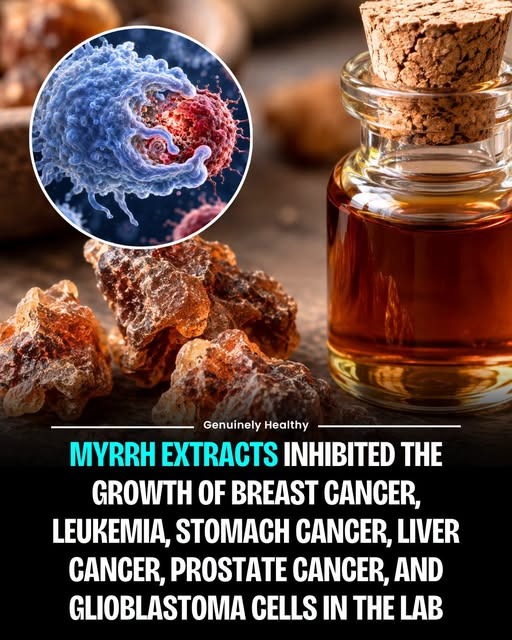
The image accompanying this recipe makes a strong claim that myrrh extracts inhibited the growth of breast cancer, leukemia, stomach cancer, liver cancer, prostate cancer, and glioblastoma cells. It is important to understand what that statement actually means. Research on myrrh’s possible anticancer properties is primarily preclinical, involving isolated compounds, cultured cells, and other laboratory models. A recent review describes promising mechanisms but also emphasizes that the evidence still needs validation in physiologically relevant models.
That means a myrrh preparation should not be considered a cancer treatment or cure, and it should never replace diagnosis, chemotherapy, radiation, surgery, immunotherapy, or other treatment recommended by a qualified healthcare professional.
With that distinction in mind, this simple infusion can be presented as a traditional herbal beverage rather than a medicinal cancer remedy.
Myrrh Herbal Infusion
Ingredients
- 1 cup water
- A food-grade myrrh product intended for oral use, used strictly according to its package directions
- 1 teaspoon honey, optional
- A small slice of fresh lemon, optional
- 1 thin slice of fresh ginger, optional
- Cinnamon stick, optional
Important: Do not improvise the amount of myrrh resin or essential oil. Myrrh products vary considerably in concentration and intended use. If the product is not specifically labeled for oral consumption, don’t add it to a drink.
Instructions
- Check the product first.
Before preparing the beverage, read the manufacturer’s directions and confirm that the particular myrrh product is intended for internal use. Essential oils and products designed for aromatherapy should not automatically be treated as edible ingredients. - Heat the water.
Place one cup of water in a small saucepan or kettle and bring it just to a boil. - Add optional ingredients.
If desired, add a small slice of ginger or a cinnamon stick to the hot water. Allow them to steep for several minutes. - Prepare the myrrh according to its label.
Follow the exact preparation instructions supplied with the food-grade myrrh product. Do not increase the quantity because you believe that a stronger preparation will provide greater health benefits. - Strain if necessary.
If you used ginger or cinnamon, remove them before serving. If the product directions call for filtering or straining myrrh, follow those instructions. - Add flavor.
Once the drink has cooled slightly, honey and lemon can be added for flavor. These ingredients are optional and don’t turn the beverage into a cancer treatment. - Serve immediately.
Myrrh has a distinctive resinous, bitter, aromatic flavor, so a small amount of honey or lemon may make the drink more pleasant.
Why Is Myrrh Being Studied?
Myrrh contains numerous naturally occurring compounds, including sesquiterpenes, triterpenoids, steroids, and phenolic constituents. Researchers are interested in whether some of these compounds can influence biological processes involved in abnormal cell growth.
A recent scientific review summarizes preclinical research suggesting that myrrh constituents may affect processes such as cancer-cell proliferation, cell-cycle regulation, apoptosis, and the tumor microenvironment. However, the same review points out important gaps, including uncertainty about mechanisms and insufficient confirmation in physiologically relevant models.
This distinction is extremely important.
A laboratory experiment might expose cancer cells directly to a purified compound at a particular concentration. A person drinking an herbal preparation does not necessarily receive the same compound, concentration, absorption, distribution, or biological exposure.
Therefore, an observation such as “inhibited cancer-cell growth in the laboratory” does not mean “prevents or treats cancer in humans.”
What Makes This Recipe Different?
This preparation is best viewed as a traditional-style herbal drink for people interested in myrrh as a botanical ingredient. It isn’t designed around a therapeutic dose.
The goal is to keep the preparation simple while avoiding the common mistake of turning promising laboratory research into an unsupported health claim.
Honey and lemon can make the flavor more approachable, while ginger and cinnamon provide additional warmth and aroma. None of these additions should be interpreted as cancer-fighting medications.
Important Safety Considerations
Natural products are not automatically safe simply because they come from plants. The National Center for Complementary and Integrative Health notes that dietary supplements can have side effects, interact with medications, and vary from the products used in scientific studies.
This is particularly important for anyone taking prescription medicines.
Herbal products can potentially alter the effects of medications, and information about many herb-drug combinations remains incomplete. NCCIH specifically recommends telling healthcare professionals about all supplements and herbal products being used.
If you are receiving cancer treatment, speak with your oncologist or pharmacist before consuming myrrh as a supplement or concentrated preparation. This is especially important because interactions involving cancer medicines can be clinically significant, and evidence about many herbal products remains limited.
Pregnant or breastfeeding individuals, children, people preparing for surgery, and anyone with a chronic medical condition should obtain professional advice before using concentrated herbal products.
Choosing a Myrrh Product
If you want to prepare this beverage, choose a product that clearly identifies the botanical ingredient and provides directions for oral use.
Avoid assuming that myrrh essential oil, incense resin, topical preparations, and oral supplements are interchangeable. They may have very different concentrations, formulations, and intended applications.
It’s also worth remembering that the product sold in a store may not be identical to the preparation examined in a scientific experiment. NCCIH notes that commercially available supplements can differ from products used in research.
For that reason, more is not necessarily better.
A Better Way to Understand the Research
The most interesting aspect of myrrh research is not that it has already been proven to cure cancer—it has not. Rather, scientists are investigating whether individual compounds in this traditional resin could eventually contribute to new therapeutic approaches.
Some laboratory studies have reported antiproliferative activity from myrrh-related compounds against cancer cell lines. For example, research involving myrrhanone-related compounds has investigated activity against prostate and other cancer-cell lines. These findings are useful for generating scientific hypotheses, but they remain laboratory evidence rather than proof of effectiveness as a human treatment.
That distinction allows the research to remain interesting without overstating what scientists currently know.